
EcoTopper
ISI · IIT JAM + GATE · CUET PG · DSE · JNU · IGIDR — all in one course
10 hrs/week
Intensive learning
400+
Video hours
35+
Mock tests
Merit scholarships up to 100% on this course — 23 scholarships awarded across our 2026 cycles. The next test cycle will be announced on our scholarship page.
Course Batches & Pricing
Evening Live Batch
7:00 PM – 8:30 PM, Mon–Fri
Duration: Till June 2027
₹45,999
Enroll Anytime
Self-Paced Course
Anytime — learn at your pace
Duration: Till June 2027
₹39,999
Enroll Anytime
Secure online payment via CCAvenue
What's Included
- 400+ Hours of Video Lectures
- 35+ Full-Length Mock Tests with Performance Reports
- Live Doubt Solving Sessions
- 3-Level Learning System (Foundation → Core → Advanced)
- Personalized Study Plan with Daily Targets
- ISI + IIT JAM + GATE + CUET PG Combo Coverage
- 24/7 Help Desk
- Free 24-Hour Demo Access
- Weekly Topic Tests + Weak Area Diagnosis
- 30-Day High-Impact Exam Strategy
- PYQs Sorted by Difficulty Level
- Class Summaries & Topic-wise Notes
- Performance-Based Counselling & Monitoring
- Indian Economy Mastery Module
- Interactive Student Portal
Syllabus
Microeconomics
Consumer Theory
- Preferences
- Utility Functions
- Indifference Curves
- Elasticity
- Complements & Substitutes
- Marginal Rate of Substitution
- Utility Maximization
- Revealed Preferences
- Marshallian & Hicksian Demand Functions
- Expenditure Functions
- Indirect Utility Functions
Producer Theory
- Production Function
- Isoquants
- Cost Function
- Short & Long Run
- Marginal Rate of Technical Substitution (MRTS)
- Returns to Scale
- Marginal Revenue
- Elasticity of Substitution
Uncertainty
- Expected Utility
- Intertemporal Choices
- Consumption Smoothing
- Risk Aversion
Game Theory
- Nash Equilibria
- Subgame Perfect Nash Equilibria
- Strategies & Payoffs
- Mixed Strategies
- Prisoners' Dilemma
- Adverse Selection
- Continuum of Actions
- Sequential Games
- Repeated Games
- Auctions
Partial Equilibrium
- Market Demand
- Short-run Supply
- Equilibrium
- Efficiency & Welfare
- Monopoly
- Price Discrimination
- Stackelberg Model
- Cournot Model
- Bertrand Model
- Tacit Collusion
- Hotelling Model
General Equilibrium
- Equilibrium
- Simple Exchange
- Edgeworth Box
- Walras' Law
- Perfect Substitutes
- Perfect Complements & Lexicographic Preferences
Welfare Economics
- Fundamental Theorems
- Equity vs Efficiency
- Social Choice Theory
- Arrow's Impossibility Theorem
Macroeconomics
IS-LM & AS-AD Models
- Classical Model
- Keynesian Model
- Goods Market
- Equilibrium in Goods Market
- Financial Market
- Liquidity Trap
- Open Market Operations
- Quantity Theory of Money
- Effect of Fiscal & Monetary Policies
- GDP
- IS-LM Curve
- LM Curve
- Labour Market
- AS-AD Curve
- Short & Medium Run
- Expectations-Augmented Phillips' Curve
- Inflation & Unemployment
- Wage Indexation
Dynamic Macroeconomics & Growth
- Harrod-Domar Model
- Solow Model
- Golden Rule
- Population Growth
- Balanced Growth
- Capital Accumulation
- Technological Progress
- INADA Conditions
Money, Banking & Inflation
- Adaptive & Rational Expectations
- Phillips Curve
- Lucas Supply
- Mundell-Fleming Model
- Dornbusch Exchange Rate Overshooting Model
- Marshall-Lerner Condition
International Economics
- Accounting in Open Economy
- Balance of Payments (BOP)
- Forex Markets
- Exchange Rates
- Comparative Advantage
International Trade
- Ricardian Model
- Heckscher-Ohlin Model
- Comparative Advantage
Statistics
Probability
- Permutations & Combinations
- Independent Events
- Bayes' Theorem
- Conditional Probability
Random Variables
- Discrete & Continuous Distributions
- Cumulative Distribution Functions
- Bivariate Distribution
- Multivariable Distribution
- Marginal Distribution
- Conditional Distribution
Expectation
- Expectation of a Random Variable
- Variance
- Moments
- Mean & Median
- Covariance
- Conditional Expectation
Special Distributions
- Bernoulli & Binomial
- Hypergeometric
- Normal Distribution
- Poisson Distribution
Estimation
- Law of Large Numbers
- Markov & Chebyshev Inequalities
- Central Limit Theorem
Hypothesis Testing
- Null & Alternative Hypothesis
- Type I & Type II Error
- P-value
- Power of a Test
- Chi-squared Test
- t-test
- Prediction
- Interval Estimation
- Confidence Interval
Regression Analysis
- PRF & SRF
- OLS Estimation
- Properties of OLS
- Classical Model Assumptions
- Goodness of Fit & R-squared
- Normality Assumptions
- Gauss-Markov Theorem
Regression Extensions
- Regression through Origin
- Scaling
- Multivariable Regression
- Standardization
- ANOVA
- Log-Linear Models
- Adjusted R-squared
Dummy Variables
- ANOVA Model
- ANCOVA Model
- Piecewise Linear Regression
- Seasonal Analysis
Relaxing the Assumptions
- Multicollinearity
- Heteroscedasticity
- Autocorrelation
Mathematics
Real Analysis
- Set Theory
- Numbers
- Sequences
- Series
- Topology of Real Numbers
- Limits
- Continuity
- Differentiation
- Integration
- Multivariable Optimization
- Two-variable Functions
- Two-variable Calculus
- Quasi Concavity & Quasi Convexity
Linear Algebra
- Linear Equations
- Linear Programming
- Linear Transformations
- Linear Independence
- Gaussian Elimination
- Matrix Algebra
- Factorization
- Vector Spaces & Subspaces
- Determinants
- Null Space, Column Space & Complete Solutions
Indian Economy
Colonial Economy
- Imperial Priorities & the Indian Economy
- Drain of Wealth
- International Trade
- Capital Flows & the Colonial Economy — Changes & Continuities
Macro Trends
- National Income
- Population
- Occupational Structure
Poverty in India
- Magnitude & Determinants
- Concepts of Poverty & Poverty Line
- Committees on Poverty Estimation
- Poverty Eradication Programmes
- Income Distribution & Inequality
Agriculture
- Agrarian Structure & Land Relations
- Agricultural Markets & Institutions — Credit, Commerce & Technology
- Trends in Performance & Productivity
- Famines
Economic Crisis of Early 1990s & Reforms
- Macroeconomic Reforms since 1991
- Structural Adjustment Programmes
- Globalisation
- Liberalisation & Privatisation
- 25 Years of Reform — Sectoral Impact
- Planning to Markets — NITI Aayog
- Demonetisation — Macroeconomic Impact
- Growth & Inequality from a Regional Lens
- New Agricultural Policy
- WTO & Indian Agriculture
- Investments & Subsidies
- Agrarian Distress
Indian Public Finance
- Fiscal Reforms post-1991
- Tax & Public Expenditure Reforms
- GST
- Public Debt & Sustainability
- FRBM Act
- Fiscal & Monetary Policy Dynamics
- Centre-State Fiscal Relations
- Cooperative & Competitive Federalism
- Role of Finance Commission & Local Bodies
Industry
- Deindustrialisation Debate
- Evolution of Entrepreneurial & Industrial Structure
- Nature of Interwar Industrialisation
- Constraints to Industrial Breakthrough
- Labour Relations
- New Industrial Policy 1991
- Public Enterprises
- MSMEs — Role, Problems, Remedies
- Role of FDI
- ICT-based Industrial Development
- Make in India














See How We Teach This Course

ISI MSQE 2026 Part B Q7 Solution | Students Asked, We Solved It Step by Step | Intertemporal Choice | EduSure School

Why Teams Bid on Players They Don't Want | IPL Game Theory | Economics of Cricket 🏏 | EduSure School
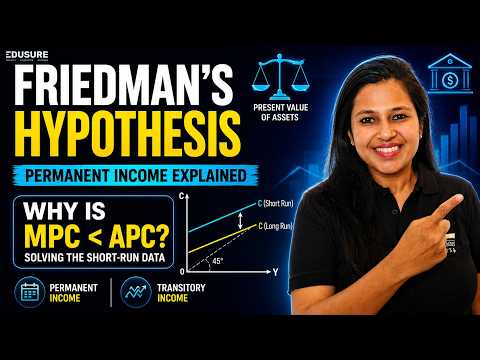
Friedman's Permanent Income Hypothesis Explained Simply 📊 #macroeconomics | EduSure School

Consumer Behaviour: Budget & Preferences
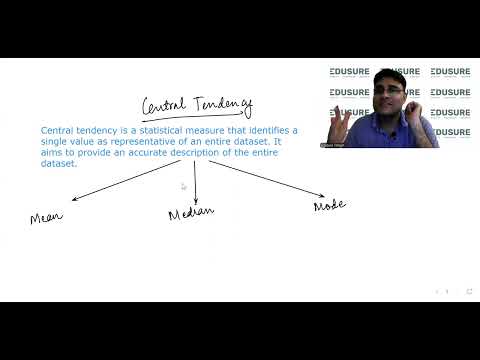
Statistics: Measures of Central Tendency
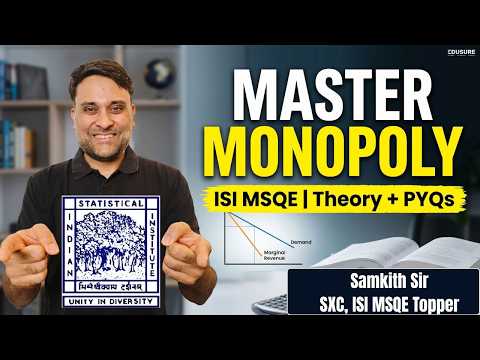
Monopoly: ISI's Favourite Market
Hear from our toppers



4.9★ on Google
· 850+ reviewsRimjhim Mondal
7 months ago
My experience at Edusure was too good. They provided me with every types of materials for each and every exam. Especially their PYQ and mock test helped me a lot during my preparation. Their support was also very helpful and beneficial for resolving any portal related issues. However it's also upon you and your hardwork while sir and ma'am eases the journey it's you who have to move forward in this journey.
Chinmya Raura
3 months ago
Amongst all the scholars and teaching institutes out there, the only one platform where I found the highest quality of educational content has been Edusure. I really appreciate the efforts put in by our teachers and their team for making it such a high quality experience for us. They really prepare you for the best!
Debadrita Chakraborty
6 months ago
I have been attending the classes for the past three months. The teaching has been excellent, and I am satisfied with the notes provided. The schedule is hectic, but the content is delivered in short, manageable chunks, which makes it easier to follow.
Abhirup Sarkar
6 months ago
I am very satisfied with the coaching institute. The faculty members are knowledgeable and supportive. They explain every concept clearly and encourage students to ask questions. The study materials in the student portal and regular tests are extremely helpful in improving performance. The learning environment is disciplined and motivating. I am happy to be part of Edusure.
Bristi Neogy
6 months ago
Edusure provided an exceptional learning environment. The teachers were excellent at clarifying complex topics, and the consistent practice through homeworks and topic test was incredibly beneficial for my discipline. I also really appreciated their efficient and dependable support for any questions I had. My exam journey was definitely made significantly easier thanks to Edusure.
Shantanu Das
7 months ago
EduSure is surely the best place for exam preparation. The mentorship is top-notch, and the environment is very motivating. The teachers here simplify difficult concepts effortlessly, and the test series helped me build the confidence I needed. Highly recommended
Frequently Asked Questions
Most EduSure courses are available as both a Live batch and a Self-Paced batch. Live batches run as Live-Sync Focus Sessions (interactive, scheduled), and every session is recorded and added to your portal, so you never lose a class. Self-Paced gives you the full recorded course to study on your own timeline.
You get weekly live doubt-solving sessions on Zoom plus ongoing doubt support between classes. Bring the doubts that remain after watching a class — the sessions are built around your questions, not generic revision.
Access continues through your exam cycle, via the EduSure student portal (website) and the EduSure app.
Recorded sessions, weekly live doubt support, class summaries, full-length mock tests with video solutions, previous-year-question (PYQ) sets, notes and a question bank, plus daily topic tests and summaries.
Yes — you can book a free guidance session or trial class so you can experience the teaching style before you decide.
EMI is available on the Eco Topper Live batch and the Eco Combined two-year package only. The maximum tenure is 3 months — there is no 6-month plan. It is not available on other courses.
A 7-day refund policy applies from the date of purchase. Refund requests go to contact@edusure.in or via call/WhatsApp. Requests after 7 days are not accepted.
EduSure courses are open to Economics and allied students preparing for PG entrances, UGC NET, or semester support — from early college years to final-year and repeat aspirants. For specific exam eligibility (such as maths background or age rules), check the official notification, as these change each year.
Classes are led by EduSure's founding faculty — Samkith Banthia (ISI MSQE alumnus; Eco(H) topper, St Xavier's Kolkata; FRM, GARP; ex-Barclays) and Mahima Banthia (DSE alumnus; Eco(H), SRCC Delhi; UGC NET; ex-St Stephen's lecturer) — along with the EduSure faculty team.
EduSure publishes named student results including 12+ All India Rank 1 finishers, with selections at ISI, DSE, JNU, IGIDR and the IITs. The institute holds a 4.9-star Google rating across 850+ reviews. The full results list is on the results page.
A single comprehensive track for all major MA/MSc Economics entrances — DU/DSE, JNU, ISI MSQE, IGIDR, Ashoka, MSE, IIFT and more.
Yes. The L1 foundation phase (included free) builds Maths for Economics and Statistics from the basics before the serious PYQ phase.
L1 is the foundation phase (basics) — typically 3 months before the L2 Eco Topper start, made especially for students who feel their basics are weak. L2 (Eco Topper) is the rank-making PYQ and application phase where theory becomes marks.
The Live batch runs scheduled, interactive Live-Sync Focus Sessions with live doubt sessions twice a week and ongoing support, and recordings are included. The Self-Paced batch is the full recorded course with doubt support in the month before the exam. Both include mocks, PYQs, and portal and app access.
The real value is the live-sync system, the PYQ-driven application phase, weekly doubt-solving and mentorship, backed by a long track record of admissions — not just recorded videos. Cheaper recordings rarely include the structure, accountability and mentorship that turn study hours into ranks.
The core MA/MSc Economics syllabus — Micro, Macro, Mathematics and Statistics — overlaps heavily across these entrances. Eco Topper teaches that common core in depth, then layers exam-specific previous-year practice so you can target several exams from one foundation.