
The Changing Landscape of MA/MSc Economics in India (2021–2026): One-Year Master’s, Data Analytics, Finance & New Pathways
For decades, the conventional route for an Economics student in India was fairly straightforward:
Bachelor's Degree → 2-Year MA/MSc Economics → Career or PhD
That model is still very much alive.
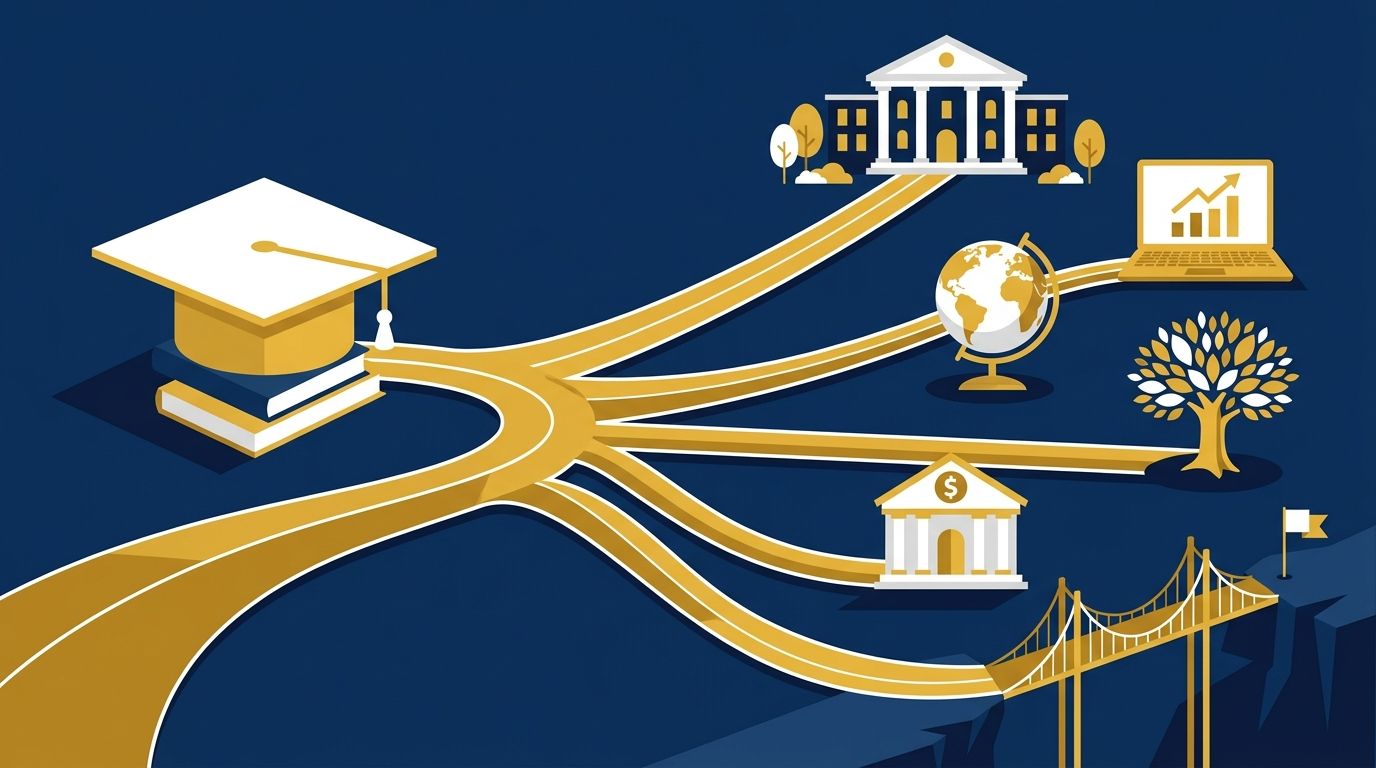
But between 2021 and 2026, something important has happened: the Indian Economics master's ecosystem has started to diversify.
Students today can increasingly choose between a traditional two-year MA Economics, a quantitative MSc, a one-year master's after a four-year bachelor's degree, Economics combined with Data Analytics, specialised programmes in Finance or Development, integrated five-year pathways, and even international 1+1 degree models.
So, is the traditional 2-year MA Economics disappearing?
Not really.
Instead, India appears to be moving from one dominant master's model towards multiple models of Economics postgraduate education.
This article examines that transformation and what it means for students looking for the best MA Economics colleges in India or the best MSc Economics colleges in India.
Table of Contents
- The traditional Economics master's
- What changed between 2021 and 2026?
- The six emerging models of Economics master's education
- One-year MA Economics and the 4+1 model
- DSE and the one-year master's route
- Ashoka, SAU and TERI: three different one-year models
- IITs and the rise of quantitative Economics
- Economics + Data Analytics
- Economics + Finance
- Economics + Development and Environment
- From one degree to a portfolio: the MSE example
- Integrated five-year Economics programmes
- The international 1+1 model
- MA vs MSc: does the degree label still matter?
- What should students compare?
- Is the 2-year MA Economics dying?
- What this means for Economics aspirants
- A new decision framework for students
- The bigger picture
- Final takeaway
- Frequently Asked Questions
1. The Traditional Economics Master's in India
The traditional Economics postgraduate structure has generally been:
3-Year Bachelor's Degree → 2-Year MA/MSc Economics → Employment / Research / PhD / Government / Finance
The curriculum typically revolves around:
- Microeconomics
- Macroeconomics
- Mathematical Economics
- Statistics
- Econometrics
- Development Economics
- Public Economics
- International Economics
- Indian Economy
This model continues to be offered by several of India's leading Economics departments and institutions.
The important point is that the traditional two-year master's has not disappeared. Instead, new pathways are being added around it.
2. What Changed Between 2021 and 2026?
The period from 2021–22 to 2026–27 is particularly interesting because several different developments have happened simultaneously.
Some institutions introduced new master's programmes. Others redesigned existing degrees. Some expanded into specialised Economics programmes. Others developed integrated undergraduate-to-master's pathways. And, increasingly, institutions began experimenting with one-year master's programmes for students with four-year bachelor's degrees.
This means that the transformation cannot be described simply as:
"India is moving from two-year master's degrees to one-year master's degrees."
That would be misleading. A better description is:
India is moving from one dominant Economics master's model towards a portfolio of different models.
3. The Six Emerging Models of Economics Master's Education
The current landscape can broadly be divided into six models.
Model 1: Traditional 2-Year MA/MSc
Examples include established programmes at institutions such as Delhi School of Economics, JNU, BHU, University of Hyderabad, CDS, and Panjab University.
Model 2: Quantitative Economics MSc
These programmes place greater emphasis on Mathematics, Statistics, Econometrics, Computational Economics, Data analysis and Programming. Examples include programmes at institutions such as IIT Kanpur, IIT Delhi and Shiv Nadar University.
Model 3: Economics + Data Analytics
Here, Economics is combined with Programming, Data Analytics, Machine Learning, Econometrics and Statistical computing. This is becoming one of the most interesting developments in the Indian Economics master's market.
Model 4: Economics + Specialisation
Instead of offering only a general Economics master's, institutions are increasingly offering specialised pathways in Financial Economics, Development Economics, Environmental Economics, Trade and Finance, Actuarial Economics, Public Policy and Quantitative Finance.
Model 5: One-Year / 4+1 Master's
Students completing a four-year bachelor's degree may increasingly have access to one-year postgraduate programmes. This creates a 4-Year Bachelor's + 1-Year Master's = 5-Year pathway.
Model 6: Integrated and International Pathways
Some institutions are combining undergraduate and postgraduate education into five-year integrated programmes. Others are offering international 1+1 dual-degree structures. The result is a much more diverse Economics master's ecosystem.
4. One-Year MA Economics: Is the 4+1 Model Taking Over?
One of the most discussed changes in postgraduate education is the emergence of the one-year master's degree. The logic is straightforward:
Earlier pathway: 3-Year Bachelor's + 2-Year Master's = 5 years
New pathway: 4-Year Bachelor's + 1-Year Master's = 5 years
The total duration may therefore remain five years, but the structure changes. However, there is an important qualification:
A one-year Economics master's is not necessarily the same academic product as a traditional two-year master's. The curriculum, entry requirements, mathematical preparation, specialisation and research expectations can differ considerably. That is why students should compare curriculum and outcomes, rather than duration alone.
5. DSE and the One-Year Economics Master's
The emergence of a one-year MA Economics route within the University of Delhi framework is particularly significant because of the position of the Delhi School of Economics (DSE) in Indian Economics education.
The established DSE model remains a two-year MA Economics programme — admission now runs through CUET PG, and we track the numbers in our guide to DSE MA Economics cutoff trends.
However, from the 2026–27 session, Delhi University has opened one-year postgraduate programmes under its NEP 2020 framework — 46 programmes and over 1,100 seats university-wide — and MA Economics is among them.
Two details students should know before reading too much into the headline:
- The one-year route is currently open only to graduates of DU's own four-year FYUP. Per the 2026 Bulletin of Information, the one-year MA Economics requires a four-year Bachelor's degree with a Major in Economics from the University of Delhi, with at least 60% (UR/OBC).
- Seats are narrow in year one. Most departments are offering roughly 40–45 one-year seats, while around 23,000 FYUP students graduate this year. The route is real, but it is a bridge — not a floodgate.
This is important not because the two-year programme has disappeared, but because it demonstrates how the 4+1 postgraduate architecture is reaching one of India's most established Economics institutions. For students researching MA Economics colleges in India, this is therefore a development worth watching closely.
The key takeaway: the one-year master's is being added to the ecosystem; it is not simply replacing the two-year master's.
6. Ashoka, SAU and TERI: Three Different One-Year Models
Perhaps the most interesting aspect of the new one-year master's landscape is that different universities are approaching it differently.
Ashoka University
Ashoka's Economics ecosystem has a strong quantitative orientation, and its one-year offering — officially the MA Economics and Data Analytics, a full-time residential programme of 40 credits across 10 courses — reflects the growing connection between Economics and computational/data skills.
The emphasis includes Economics, Data Analytics, Finance and Machine Learning. This represents an Economics + Data model.
South Asian University
South Asian University offers its MA Economics with a specialisation in Economic Development in either one-year or two-year durations (per its official admissions page). This represents an Economics + Development model rather than simply a shorter version of a general Economics degree.
TERI School of Advanced Studies
TERI SAS has introduced a one-year MSc Economics (part of its 2026 rollout of one-year master's programmes) with a strong focus on Environmental Economics, Natural Resource Economics, Climate, Energy, Policy and Applied research. This creates an Economics + Environment model. Notably, TERI also runs a four-year FYUP and a five-year integrated FYIPP in Economics — several structural models stacking up inside one institution.
Why is this important?
Consider the four approaches:
| Institution | One-Year Orientation |
|---|---|
| Ashoka | Economics + Data Analytics |
| SAU | Economics + Development |
| TERI SAS | Economics + Environment |
| DSE (DU) | General Economics |
The duration is similar. The academic proposition is not. This is one of the biggest changes students need to understand when comparing one-year MA Economics programmes in India.
7. IITs and the Rise of Quantitative Economics
Another major development has been the growing presence of IITs in postgraduate Economics.
IIT Kanpur
IIT Kanpur's two-year MSc Economics programme was launched in the 2023–24 academic year. From the 2026–27 admission cycle, entry runs through IIT JAM — the Economics (EN) paper (24 seats) and the Mathematical Statistics (MS) paper (16 seats). If you are preparing for that route, see our IIT JAM Economics 2027 guide.
Its curriculum reflects the changing skill requirements of Economics. Students encounter areas such as Econometrics, STATA, R, Python, MATLAB, Causal Evaluation, Computational Economics, Energy Markets and Auction Design — a clear example of the growing overlap between Economics, computation and data.
IIT Delhi
IIT Delhi's two-year MSc Economics programme (Department of Humanities & Social Sciences, admission through JAM) similarly combines Economics with quantitative and interdisciplinary training — research-oriented components, analytical training and project work, inside a technology-focused institution.
IIT Roorkee
IIT Roorkee provides both postgraduate and integrated pathways in Economics. Its five-year BS–MS (Economics) dual degree — entry via JEE Advanced, with an exit option after four years with a BS degree — is particularly relevant to the broader trend of combining undergraduate and postgraduate education.
The larger trend
The rise of Economics programmes within technology-oriented institutions is significant. It suggests that the Economics graduate of the future may need to be comfortable not only with economic theory, but also with:
Mathematics + Statistics + Econometrics + Programming + Data
8. Economics + Data Analytics: A New Category?
Perhaps the most important curricular trend is the rise of Economics and Data Analytics. Traditional Economics education already uses statistics and econometrics. What is changing is the depth and breadth of computational training.
A modern quantitative Economics curriculum can increasingly look like:
Economics + Statistics + Econometrics + R / Python + Machine Learning + Data Analytics → "Economics + Data"
This model can be seen in different forms across institutions.
Ahmedabad University
Ahmedabad University's Economics programme has moved from the earlier MA structure — "erstwhile administered as MA Economics", in the university's own words — to an MS Economics framework that places significant emphasis on Data Analytics, R, Python, Econometrics, Financial Econometrics, Machine Learning for Policy, Research Writing, Dissertation and Capstone work.
Shiv Nadar University
The MSc Economics curriculum combines economic theory with Mathematical methods, Statistics, Econometrics, Programming and Research training.
Central University of Andhra Pradesh
The university offers MSc Economics & Data Analytics (two-year), combining Economics with R, Python, Econometrics, Data Analytics, Industry interaction, Internship and Dissertation.
Why is this trend important?
Because employers increasingly value graduates who can move from:
Economic question → Data → Econometric model → Analysis → Policy/business conclusion
The Economics degree is therefore becoming more computational.
9. Economics + Finance
Finance is another area where Economics master's programmes are becoming more specialised. Examples include:
- Madras School of Economics: MA Financial Economics; MA Applied Quantitative Finance
- University of Hyderabad: MA Financial Economics
- IIFT: MA Economics with specialisation in Trade and Finance (running since 2018, Delhi and Kolkata campuses)
- NMIMS: MSc Economics, plus the international dual-degree opportunity detailed below
- Gokhale Institute: a postgraduate portfolio that includes specialised Economics programmes connected to areas such as Financial Economics and International Business Economics & Finance
The larger trend is clear:
Economics master's programmes are increasingly being designed around specific career domains.
10. Economics + Development + Environment
Finance is not the only area of specialisation. Development Economics remains a major area of postgraduate study, while environmental and resource economics are becoming increasingly important.
Development: institutions such as South Asian University, JNU, CDS and BASE provide pathways with strong development/policy relevance.
Environment: institutions such as TERI SAS, Madras School of Economics and IGIDR provide programmes or specialisations connected with Environmental Economics, Natural Resources, Energy, Climate and Sustainable Development.
This creates another important choice for students:
Do you want a broad Economics master's or do you want to specialise earlier?
11. From One Degree to a Portfolio: The MSE Example
The evolution of the Madras School of Economics (MSE) is an important example of how the landscape is changing. In April 2021, MSE became an "Institution of Special Importance" under the MSE Act 2020, gaining its own degree-granting power — and its master's portfolio today spans five areas:
- General Economics
- Financial Economics
- Applied Quantitative Finance
- Environmental Economics
- Actuarial Economics
(MSE also runs a five-year Integrated MA in Economics with exit options — more on integrated pathways below.)
The significance of this development is bigger than the number of programmes. It represents a movement from "one Economics master's" towards "a portfolio of Economics master's degrees". Students can increasingly choose a degree based on their intended domain rather than simply choosing "MA Economics." We break down each option in our guide to MA Economics programmes at MSE.
12. Integrated Five-Year Economics Programmes
Another emerging pathway is the integrated Economics master's. Instead of completing a bachelor's degree first and then applying for a master's, students can enter a five-year integrated programme.
University of Hyderabad
Its School of Economics offers a five-year Integrated MA in Economics alongside its standalone MA Economics and MA Financial Economics programmes. Students progress through a structured five-year academic pathway, with exit options built into the programme.
BASE (Dr B. R. Ambedkar School of Economics University)
BASE illustrates the portfolio approach as well: its flagship five-year Integrated MSc in Economics (with an exit option after three years with a BSc (Hons)) sits alongside two-year MSc Economics and MSc Financial Economics programmes.
IIT Roorkee
Its integrated BS–MS Economics pathway (Section 7) is another example of Economics education being embedded into longer undergraduate-to-postgraduate structures.
Why does this matter?
For a student finishing Class 12, the decision is no longer necessarily "Which BA Economics should I do?" It can increasingly become:
"Do I want a standalone bachelor's followed by a master's, or do I want an integrated Economics pathway?"
13. The International 1+1 Model
Internationalisation is another direction in which Economics master's programmes are evolving. A notable example is the NMIMS–Virginia Tech dual-degree structure — announced in 2023 as India's first dual-degree master's programme in economics.
The broad model is:
Year 1: NMIMS (Mumbai) → Year 2: Virginia Tech (Blacksburg, USA) → Two degrees: MSc Economics (NMIMS) + MA Economics (Virginia Tech)
The programme highlights areas including Big Data Economics, Computational Finance, Behavioural Economics and Business Forecasting.
This represents a different proposition from the conventional domestic two-year master's. Instead of simply shortening the degree, the programme adds international exposure + specialised training + dual credentials.
14. MA vs MSc: Does the Degree Label Still Matter?
Historically, students often assumed MA Economics = traditional Economics and MSc Economics = more quantitative Economics. That distinction is becoming less reliable.
An MA Economics programme can include substantial Mathematics, Econometrics, Statistics, Programming and Data Analysis. At the same time, an MSc Economics can have substantial interdisciplinary or policy components. Ahmedabad University is an especially interesting example of this evolution, having moved from an MA Economics structure to an MS Economics framework with strong quantitative, computational and applied components.
Don't choose an Economics master's only because it says MA or MSc. Look at Mathematics, Statistics, Econometrics, Programming, Research, Specialisations, Dissertation, Internships and Career outcomes. The curriculum matters more than the label.
15. What Should Students Compare When Choosing an Economics Master's?
The question "Which is the best MA Economics college in India?" is useful — but incomplete. Students should compare at least seven dimensions.
1. Duration
Is it 1 year, 2 years, or a 5-year integrated programme?
2. Mathematical Intensity
How much Calculus, Linear algebra, Optimisation and Mathematical Economics?
3. Econometrics
Does the programme include basic econometrics, advanced econometrics, time series, causal inference, or financial econometrics?
4. Programming
Does the programme teach R, Python, STATA, MATLAB or other computational tools?
5. Specialisation
Can students specialise in Finance, Development, Environment, Data, Public Policy or Trade?
6. Research
Look for a Dissertation or Thesis, research seminars, independent research and faculty interaction.
7. Career Orientation
Finally, ask what you want after the master's:
- PhD / Academia? Prioritise mathematical and research depth.
- Data / Analytics? Prioritise programming, econometrics and machine learning.
- Finance? Look for financial economics and quantitative finance.
- Policy / Development? Look for development, public economics and policy training.
16. Is the 2-Year MA Economics Dying?
No. The evidence points towards something more nuanced. The traditional two-year master's continues to be offered by many major institutions. At the same time, new pathways are emerging around it.
The Indian Economics master's market is therefore becoming:
- More diverse
- More quantitative
- More specialised
- More computational
- More interdisciplinary
- More international
The biggest change is not the disappearance of the two-year master's. It is the loss of the idea that there is only one correct Economics master's model.
17. What Does This Mean for Economics Aspirants?
For students preparing for Economics entrance examinations, this changing landscape has an important implication. Entrance preparation should not be viewed only as a way to clear an examination.
A strong foundation in Microeconomics, Macroeconomics, Mathematics, Statistics and Econometrics remains extremely valuable. But students should also begin thinking about the skills they will need after admission.
The Economics student of the future may need to combine:
Economic Theory + Quantitative Methods + Econometrics + Programming + Data Analysis + Research
That is why choosing the right master's programme is becoming almost as important as getting into a good institution.
18. A New Decision Framework for Students
Before applying to an Economics master's programme, ask yourself: "What kind of economist do I want to become?"
| Your goal | Prioritise in a programme |
|---|---|
| Research / PhD | Mathematics + Econometrics + Research depth |
| Data / Analytics | Econometrics + R/Python + Machine Learning |
| Finance | Financial Economics + Econometrics + Quantitative Finance |
| Development / Policy | Development Economics + Public Economics + Policy training |
| You have a 4-year bachelor's | One-year / 4+1 master's routes |
| International exposure | Dual-degree / 1+1 programmes |
19. The Bigger Picture
The transformation of Economics postgraduate education in India can be summarised in one chain:
Traditional model (2-year MA/MSc) → Quantitative model (Economics + Mathematics + Econometrics) → Computational model (Economics + Data + Programming) → Specialised model (Finance / Development / Environment / Policy) → New structural models (1-Year / 4+1 / Integrated / International)
The direction is therefore not 2-Year → 1-Year.
It is ONE MODEL → MULTIPLE MODELS.
20. Final Takeaway
The period from 2021 to 2026 has not marked the end of the traditional Economics master's in India. Instead, it has marked the beginning of a much more diverse postgraduate ecosystem.
Students can now increasingly encounter:
- Traditional 2-year MA Economics
- Quantitative MSc Economics
- Economics + Data Analytics
- Economics + Finance
- Economics + Development
- Economics + Environment
- One-year master's programmes
- 4+1 pathways
- Integrated five-year degrees
- International 1+1 programmes
The biggest lesson for students is simple:
Don't choose an Economics master's only by its name, duration or ranking. Look at what the programme actually teaches.
Because the most important question is no longer simply "Which MA Economics college should I choose?"
It is: "Which model of Economics master's is right for me?"
How EduSure Can Help
For students targeting competitive Economics postgraduate programmes, strong preparation in Microeconomics, Macroeconomics, Mathematics, Statistics and Econometrics remains fundamental.
EduSure focuses on structured preparation for Economics entrance examinations, helping students build the conceptual and quantitative foundations required for competitive postgraduate Economics programmes. If CUET PG is your route, start with our CUET PG Economics 2027 syllabus decode and our free past-papers library.
Explore EduSure's Economics entrance preparation programmes to plan your preparation strategically.
Frequently Asked Questions
1. Is a 2-year MA Economics still available in India?
Yes. Several leading institutions continue to offer two-year MA/MSc Economics programmes. The emergence of one-year programmes does not mean that the traditional two-year model has disappeared.
2. What is a 4+1 master's in Economics?
A 4+1 pathway generally refers to a four-year bachelor's degree followed by a one-year master's degree, making five years of undergraduate-plus-postgraduate education in total.
3. Which colleges offer a one-year MA Economics in India?
The one-year Economics landscape includes different models. Examples include the one-year MA Economics route in Delhi University's 2026–27 framework (currently open to DU's own four-year FYUP graduates), Ashoka University's MA Economics and Data Analytics, South Asian University's one-year Economics pathway with a Development specialisation, and TERI SAS's one-year MSc Economics focused on environment and natural resources.
4. Is MA Economics better than MSc Economics?
Neither degree label is automatically better. Students should compare the curriculum, mathematics, econometrics, programming, specialisations, research opportunities and career outcomes.
5. Is Economics becoming more data-oriented?
Yes. Increasingly, Economics master's programmes are incorporating programming, data analytics, econometrics, machine learning and computational methods.
6. Should I choose a one-year or two-year Economics master's?
It depends on your academic background and goals. A student with a four-year bachelor's degree and strong Economics/quantitative preparation may find a one-year programme attractive, while students seeking broader training or deeper foundational preparation may prefer a two-year programme.
7. What should I look for in the best MSc Economics colleges in India?
Look beyond rankings. Examine mathematical rigour, econometrics, programming, faculty, research opportunities, dissertation requirements, internships, specialisations and placement/career outcomes.