
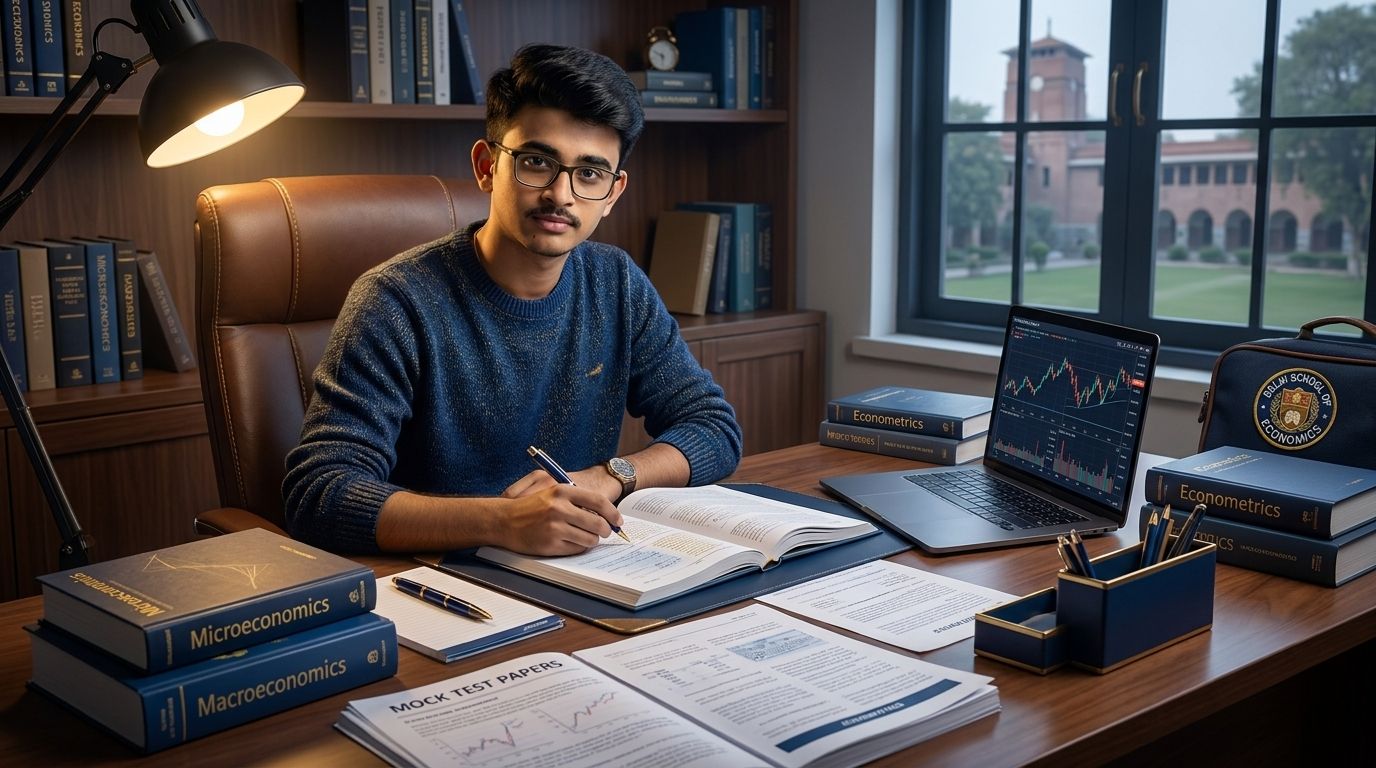
From Silchar to DSE: Shivank Sinha's Blueprint for Cracking Multiple Economics Entrances in 2026
Most students believe that getting into the Delhi School of Economics requires a background from a top Delhi college or a coaching hub in Kota or Delhi itself. Shivank Sinha proved that assumption wrong.
Coming from Silchar, a town in Assam with limited access to elite academic networks, Shivank graduated in Economics Honours from Assam University. After missing his dream college post-Class 12, he set a singular goal: crack India's toughest economics entrance exams and secure a seat at a premier institution. Two years later, he had not just one offer. He had three — from DSE, JNU, and IGIDR.
This is his exact blueprint, extracted from a detailed conversation about how he studied, what he sacrificed, and what he would do differently.
The Starting Point: Turning a Class 12 Setback into Fuel
Shivank's journey did not begin with confidence. It began with a disappointment.
After Class 12, he did not secure admission to his desired undergraduate college. Rather than settling, he used that setback as motivation. He researched India's top MA Economics programmes — DSE, IGIDR, IITs, ISI — and realized that a master's degree from a premier institution could completely reset his academic trajectory.
He chose a two-year foundational coaching program with EduSure, designed for students who want to build from the ground up. This was not a last-minute crash course. It was a deliberate, long-term investment in systematic preparation.
Key Insight: Shivank did not wait until his final year to start. He began in his second year, giving himself 18+ months of structured preparation. This early start was the single biggest factor in his ability to cover the vast syllabus without panic.
The Study System: How He Actually Learned
Shivank's approach was methodical. He did not rely on any single resource. He built a layered system:
1. Triple-Layered Notes
He combined three inputs into his own consolidated notes:
- Live lectures from faculty (attended consistently, never skipped)
- Portal notes from the coaching platform (used as structured reference)
- Standard reference books (for depth and alternative explanations)
This was not passive highlighting. He actively rewrote concepts in his own words, creating concise, personally meaningful notes that exceeded 1,000 pages across the full syllabus. He covered approximately 70–80% of this material in depth.
2. Volume-Based Problem Solving
Shivank did not believe in "understanding once and moving on." For every chapter, he solved 80 to 140 practice questions. This was not rote repetition. It was pattern recognition.
The volume allowed him to:
- Identify recurring question types and shortcuts
- Build "trick notes" — a dedicated notebook for non-obvious shortcuts and edge cases
- Develop instinctive recognition of how examiners frame questions
3. The "Mistakes Copy"
During every mock test, Shivank maintained a separate "mistakes copy." This was not just a list of wrong answers. It was a diagnostic tool:
- What was the conceptual gap?
- Was it a calculation error or a misunderstanding?
- Would he have made the same mistake under less time pressure?
By reviewing this copy before every subsequent mock, he systematically eliminated recurring errors. Students who improved 30+ marks between their first and final mocks all followed this exact discipline.
The Daily Schedule: How He Balanced College and Coaching
Shivank managed the dual load of undergraduate coursework and entrance preparation by strictly partitioning his day.
| Time | Activity |
|---|---|
| 9 AM – 1 PM | Undergraduate college classes and assignments |
| 2 PM – 5 PM | Coaching class / lecture attendance |
| 5 PM – 7 PM | Break, rest, mental reset |
| 7 PM – 10 PM | Self-study — problem solving, notes revision, or mock test analysis |
| 10 PM – 12 AM | Light revision or trick notes review (when energy allowed) |
Scheduling Flexibility for Weak Areas: On days when Statistics or another weak subject demanded extra attention, Shivank shifted his schedule. He often started focused self-study at 4 PM instead of 7 PM, compressing the evening break but ensuring his weakest subjects got his freshest mental energy. This was not a permanent schedule change. It was a tactical adjustment — one he made only when his error log showed that a specific subject was bleeding marks.
The Discipline Rule: 6 Out of 7 Days
Shivank was realistic about perfection. He aimed for complete adherence 6 days a week. One day was always lighter — either a scheduled break or a reduced-load day. This prevented burnout and sustained his energy across the two-year preparation period.
"Perfect adherence is unrealistic. But if you maintain consistency on 6 out of 7 days, you are already ahead of 90% of aspirants."
Conquering Weakness: How He Mastered Statistics
Statistics was Shivank's weakest subject when he started. He had minimal exposure to probability, distributions, or hypothesis testing in his undergraduate programme.
His recovery strategy was three-pronged:
- Standard reference book: He used S.C. Gupta's Fundamentals of Mathematical Statistics as his primary text, working through solved examples line-by-line.
- Faculty guidance: He attended every doubt-clearing session and did not hide his weakness. He asked foundational questions until he genuinely understood.
- Mind maps: He created visual, personalized mind maps for every major Statistics topic — probability distributions, sampling theory, hypothesis testing, regression. These became his primary revision tool in the final month.
By the end of his preparation, Statistics was no longer his weakness. It was his most confidently scored section in several mocks.
The Counterintuitive Exam Strategy: NAT First
Shivank developed a highly specific strategy for IIT JAM Economics that most students avoid: he started with the NAT (Numerical Answer Type) section first.
This is counterintuitive. NAT questions have no options. They appear harder. Most students skip them and return at the end, often leaving them entirely.
Shivank's reasoning:
- NAT questions are high-scoring but low-probability guessing. If you attempt them early, you solve them with a fresh mind.
- If you leave them for the end, panic makes even solvable questions impossible.
- After NAT, he moved to MSQ (Multiple Select Questions), then finally MCQ (Multiple Choice Questions).
This strategy demands one prerequisite: You must have practiced NAT questions so extensively that you recognize their patterns. Shivank had solved hundreds of NAT-type numericals in his preparation. Without that volume, NAT-first is suicide. With it, NAT-first is a rank booster.
The Mindset: Exams Are Weird for Everyone
Shivank's most valuable psychological insight was simple: the exam paper will feel weird. Accept it.
In both IIT JAM and CUET PG, he encountered questions that felt unfamiliar, oddly framed, or deliberately disorienting. His peers panicked. He did not.
His reasoning:
- If the paper is weird, it is weird for everyone.
- Panic does not improve your score. Steady execution does.
- Your relative performance matters, not your absolute comfort.
He had a pre-planned question-selection strategy. He followed it. He did not deviate because the paper "felt different."
This calm, almost mechanical approach to exam execution was the result of 40+ full-length mocks. By the time he sat for the actual exam, the pressure felt familiar. He had practiced the pressure more than most students had practiced the syllabus.
Stepwise Learning: From Full Derivations to Exam Efficiency
Shivank's initial approach was deliberately slow and thorough:
- Every derivative was written step-by-step.
- Every calculation was shown in full.
- Every proof was reconstructed from first principles.
This was not inefficient. It was foundational. By writing everything out, he built genuine conceptual clarity. He could not fool himself with shortcuts.
In the final 3 months, he gradually compressed his written work. He eliminated redundant steps. He developed mental shortcuts. He learned to write only the essential working — critical for exams where answer space and time are both limited.
This two-phase approach — full detail first, efficiency second — allowed him to solve complex econometrics problems that produced unexpected intermediate results. Because he understood the full derivation, he could recognize when a "weird" intermediate result was actually correct, and continue to the final answer.
Last-Minute Revision: The Three-Layer System
Shivank did not believe in "cramming" the night before an exam. He believed in layered revision — a system that compressed months of work into a few hours without losing depth.
Layer 1: Detailed Notes (The Foundation) His 1,000+ pages of consolidated notes were the base. These were not read cover-to-cover in the final week. They were used as a reference — when a mind map triggered a doubt, he returned to the detailed derivation to confirm the logic.
Layer 2: Condensed Mind Maps (The Memory Trigger) In the final month, Shivank created one-page mind maps for every major topic. These were visual, color-coded, and personally meaningful. They contained only the concepts he personally found difficult — the specific formulas, the non-obvious shortcuts, and the "trick" patterns he had identified through his 80–140 questions per chapter.
Layer 3: The Mistakes Copy (The Final Filter) On the day before the exam, Shivank did not open textbooks. He opened his mistakes copy and trick notes. He solved 20–30 questions from this copy — only the ones he had gotten wrong in the last 10 mocks. If he got them right, he moved on. If he got them wrong, he revisited the mind map for that topic.
The Day Before the Exam: High-Yield Only
- No new material. No new mocks. No new concepts.
- Only mind maps, mistakes copy, and trick notes.
- Focus on "high-yield" topics — the 20% of the syllabus that contributed to 80% of his mock errors.
- Sleep before 10 PM. No screen time after 8 PM.
Competitive Mindset: Maximizing Limited Resources
Shivank never pretended his background was equivalent to students from Delhi or Mumbai. He acknowledged it openly. He had fewer peers preparing for the same exams. He had less access to informal study groups. He had no senior at his college who had cracked DSE.
But he also recognized that he had the same textbooks, the same portal, and the same faculty. His competitors had advantages, but he had access to the same core resources. The question was not who had more. It was who used what they had more completely.
This is the competitive mindset that separates students who qualify from students who do not. It is not about equal starting points. It is about equal utilization of available resources.
The Results: Three Offers, One Choice
Shivank's final result set was exceptional:
- CUET PG Economics 2026: High score (270+ range), competitive rank
- IIT JAM Economics 2026: AIR 49
- GATE Economics 2026: Qualified with competitive score
- Offers: DSE, JNU, and IGIDR
He chose DSE — the Delhi School of Economics — as his final destination. His rationale was direct: DSE's quantitative rigour, alumni network, and placement ecosystem aligned with his long-term career goals in economics research and corporate analytics.
From Offers to Ambition: What Comes After DSE
Shivank did not stop at admission. For him, DSE was not the finish line. It was the starting line.
He expressed explicit enthusiasm about breaking institutional records at DSE. His ambition was not merely to survive the programme. It was to excel within it — to leverage DSE's research infrastructure, corporate connections, and alumni network to build a career trajectory that his undergraduate background alone could never have provided.
This forward-looking mindset is what distinguishes students who use DSE as a credential from students who use DSE as a launchpad. Shivank intends to be the latter.
For 2027 aspirants: Your goal is not just admission. Your goal is to enter DSE with the skill and confidence to compete with students who had more resources than you. That preparation begins now — not in the first semester.
Self-Awareness and Adaptability: The Strategy Evolved Through Trial and Error
Shivank did not follow a rigid plan from Day 1. His preparation evolved through continuous self-assessment and adjustment.
In the first 3 months, he tried multiple note-taking formats, different daily schedules, and various revision techniques. Some failed. He abandoned them. Others worked. He doubled down on them. By Month 6, he had a personalized system that no coaching manual could have prescribed — because it was built for his specific memory, his specific gaps, and his specific energy patterns.
Key Insight: Your optimal preparation system is not found in a book. It is discovered through iteration. Start with a framework, track what works, and have the honesty to discard what does not. The best plan is the one you actually follow — not the one that sounds most impressive on paper.
What Shivank Would Tell a 2027 Aspirant
- Start early, but start structured. The 18-month timeline allowed him to cover the syllabus twice. A 6-month crash course would not have worked for him, given his background.
- Write everything in full detail first. Do not skip steps because you "understand the concept." You only understand it when you can derive it from scratch.
- Create personalized revision tools. Shivank's mind maps and trick notes were useless to anyone else. That was the point. They were optimized for his memory, his gaps, and his patterns.
- Take every exam seriously. He prepared for IIT JAM, GATE, and CUET PG simultaneously. Each exam reinforced the others. The overlap was significant. The extra effort was marginal compared to the expanded opportunities.
- Mocks are not tests. They are practice for the pressure. Shivank treated every mock as a rehearsal for the mental state of the exam hall. He practiced calm execution, not just correct answers.
- Accept sacrifices, but schedule breaks. He missed social events, festivals, and leisure time. But he also took planned breaks. He knew that burnout was a bigger risk than missing one study session.
- Your background is not your ceiling. Coming from Silchar, from Assam University, without a Delhi or Mumbai network — none of this stopped him. What mattered was the daily execution of a structured plan.
Frequently Asked Questions (FAQs)
1. Can a student from a non-premier college or small town crack DSE?
Yes. Shivank is from Assam University, Silchar — not a Tier-1 metro college. His success came from structured coaching, disciplined self-study, and volume-based practice. Geography and college brand are not determinants.
2. How early should I start preparing for MA Economics entrances?
If you are in a 3-year BA programme, start in your 2nd year. Shivank's 18-month timeline allowed him to build foundations, practice extensively, and revise without panic. A 6-month crash course works only for students with exceptional prior mathematical preparation.
3. What is the best way to handle a weak subject like Statistics?
Do not hide from it. Use a standard reference book (like S.C. Gupta), attend every doubt session, and create visual mind maps. The goal is not to tolerate Statistics but to convert it into a strength.
4. Is it better to focus on one exam or prepare for multiple?
Prepare for multiple. CUET PG, IIT JAM, and GATE have overlapping syllabi in Micro, Macro, Math, and Statistics. The marginal effort for each additional exam is small. The marginal benefit — multiple offers, backup options, and psychological security — is enormous.
5. How many mocks are enough for CUET PG or IIT JAM?
Shivank attempted 40+ full-length mocks across all exams. This is not excessive. It is the threshold where exam pressure becomes familiar rather than terrifying. For CUET PG specifically, 30+ full mocks in the final 6 months is a realistic minimum for serious aspirants.
6. What is the most underrated preparation tool?
The "mistakes copy" and "trick notes." Most students review mock scores. Few students review mock errors with diagnostic precision. Shivank's trick notes — a dedicated notebook for non-obvious shortcuts and edge cases — gave him speed advantages in the actual exam that no textbook could provide.
Want to build a preparation system like Shivank's? Explore the EduSure Eco Topper Course — a structured 2-year programme designed for students who refuse to let their starting point define their destination. From Silchar to DSE — and beyond.
Also read: CUET PG Economics 2026 Results: Score Analysis & Cutoffs and the 8-Month Roadmap from Zero to 270+ to build your own blueprint.