
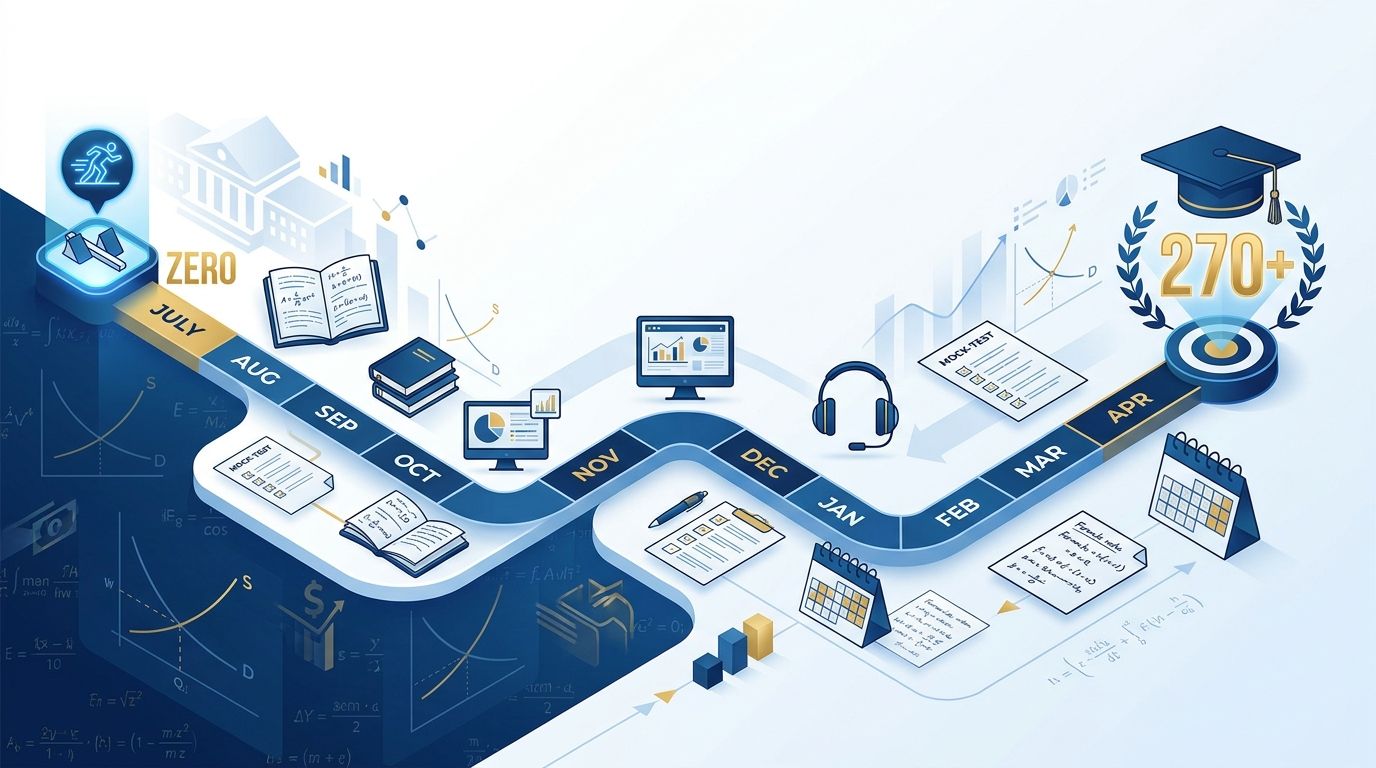
CUET PG Economics 2027: The 8-Month Roadmap from Zero to 270+ (Complete Beginner's Guide)
If you are a third-year undergraduate student in July 2026, you are standing at the exact moment where preparation separates panic from precision. The CUET PG Economics 2027 exam is scheduled for April 2027. That gives you roughly 8 months — from July to April — to build a 270+ score from any starting point. This is not a hypothetical promise. It is a structured execution plan.
Most students waste the first 3 months reading textbooks cover-to-cover. Then they panic in January because they have not solved a single timed mock. This roadmap is designed to prevent that exact mistake. Every month has a specific target. Every week has a measurable output. And every day has a clear task.
Why 8 Months? The July-to-April Cycle
The CUET PG Economics 2027 timeline follows a predictable arc:
- July–August 2026: Foundation building. You are still in college. Your 5th semester subjects can double as entrance preparation.
- September–October 2026: Core syllabus coverage. You should finish 70% of the syllabus by Diwali.
- November–December 2026: Speed and accuracy training. Mocks begin in earnest. Error logging becomes a daily habit.
- January–February 2027: Revision and weak-area blitz. No new topics. Only consolidation.
- March–April 2027: Peak performance. Full mocks, past papers, and final strategy refinement.
Starting in July is not early. It is optimal. Starting in January is possible, but it compresses the revision phase into a panic sprint. Do not do that to yourself.
Month 1–2: Foundation (July–August 2026)
Goal: Master the mathematical and microeconomic foundations that every other subject rests upon.
Mathematics
- Linear Algebra: Matrices, determinants, eigenvalues, vectors, systems of linear equations
- Calculus: Multi-variable differentiation, partial derivatives, optimization (Lagrange multipliers), basic integration
- Real Analysis: Sequences, limits, continuity, basic proof structures (especially for ISI-parallel students)
Microeconomics
- Consumer Theory: Utility maximization, demand derivation, expenditure minimization, Slutsky equation, revealed preference
- Producer Theory: Cost minimization, profit maximization, supply curves, cost curves (short-run and long-run), perfect competition, monopoly basics
- Market Structures: Perfect competition, monopoly, monopolistic competition, oligopoly (Cournot, Stackelberg, Bertrand basics)
- Game Theory: Nash equilibrium, dominant strategies, mixed strategies (high-yield for CUET PG)
Macroeconomics
- National Income Accounting: GDP, GNP, NDP, NNP, real vs nominal, price indices
- Classical and Keynesian Models: IS-LM derivation, AD-AS framework, policy multipliers, fiscal and monetary policy effectiveness
- Open Economy Models: Mundell-Fleming model, balance of payments, exchange rate basics
- Growth Models: Solow model, Harrod-Domar basics, endogenous growth introduction
Statistics & Probability
- Descriptive Statistics: Mean, median, mode, variance, standard deviation, covariance, correlation
- Probability Theory: Bayes' theorem, conditional probability, random variables, expectation, variance
- Probability Distributions: Normal, binomial, Poisson, uniform — their properties and applications
- Sampling: Central limit theorem, standard error, sampling distributions
Indian Economy (Light Touch)
- Start reading the Economic Survey 2025–26 summary and Union Budget 2026 highlights
- Basic structure: Sectors of Indian economy, GDP composition, poverty and inequality measures
Daily Output Target: 2 hours Mathematics problem solving | 2 hours Microeconomics theory + numericals | 1 hour Macroeconomics or Statistics | 30 minutes Indian Economy reading
Weekly Milestone: Solve 50+ Mathematics problems, complete 1 full Micro chapter with past-year MCQs, maintain a running formula sheet
Month 3–4: Core Build (September–October 2026)
Goal: Finish 70% of the full syllabus before Diwali.
Microeconomics (Advanced)
- General Equilibrium: Edgeworth box, Walrasian equilibrium, welfare theorems
- Market Failure: Externalities, public goods, asymmetric information (adverse selection, moral hazard)
- Advanced Game Theory: Sequential games, backward induction, repeated games, auction theory basics
Macroeconomics (Advanced)
- Growth Theory Deep Dive: Solow model with population growth and technological progress, Ramsey-Cass-Koopmans basics
- Business Cycles: Real business cycle theory, New Keynesian economics, Phillips curve (short-run and long-run)
- International Trade: Ricardian model, Heckscher-Ohlin, trade policy (tariffs, quotas), balance of payments
Statistics & Econometrics
- Hypothesis Testing: Z-test, t-test, chi-square, F-test, Type I and Type II errors, p-values
- Regression Basics: OLS derivation, Gauss-Markov theorem, R-squared, adjusted R-squared
- Violations of Assumptions: Heteroscedasticity, multicollinearity, autocorrelation — detection and consequences
- Time Series: Stationarity, AR, MA, ARMA basics (high-yield for CUET PG)
Indian Economy (Deepened)
- Planning and Development: Five-Year Plans, NITI Aayog, sustainable development goals
- Agriculture: Land reforms, Green Revolution, MSP, farm bills (current debates)
- Industry and Services: Make in India, service sector dominance, startup ecosystem
- Financial Sector: Banking reforms, RBI monetary policy, NBFCs, digital payments
- External Sector: Trade deficit, FDI, FPI, FOREX reserves, exchange rate management
Public Finance
- Taxation: Direct vs indirect, GST structure, fiscal deficit, revenue deficit, primary deficit
- Government Budget: Budget components, FRBM Act, fiscal consolidation
- Public Expenditure: Revenue vs capital, plan vs non-plan, subsidies
Daily Output Target: 1.5 hours Mathematics (advanced) | 1.5 hours Micro or Macro (alternating) | 1 hour Statistics/Econometrics | 1 hour Indian Economy/Public Finance | 30 minutes current affairs
Weekly Milestone: Complete 2 full chapters per week, solve 100+ MCQs from past papers, start a chapter-wise error log
Diwali Checkpoint (End of October): You should have completed — Micro (100%), Macro (100%), Math (100%), Stats (90%), Indian Economy (70%), Public Finance (60%). If you are behind, use the November buffer to catch up.
Month 5–6: Speed & Accuracy (November–December 2026)
Goal: Transition from "knowing" to "solving fast." This is where CUET PG is won or lost.
Mock Test Protocol (Starting Week 1 of November)
- Frequency: 1 full-length mock every Saturday, 1 sectional test every Wednesday
- Mock Source: Computer-based mocks that replicate the NTA interface (75 questions, 120 minutes, +4/-1 marking)
- Post-Mock Analysis (Mandatory, 2 hours):
- Time taken per question — identify time traps
- Accuracy by topic — which subjects are bleeding marks?
- Error categorization: Conceptual gap / Silly mistake / Time pressure / Guessing wrong / Formula confusion
- Revision list: 5 topics to revisit before next mock
Speed Drills (Daily, 30 minutes)
- 20 rapid MCQs with a 30-minute timer
- Focus on high-yield topics: Probability distributions, Game theory, National income, Budget data, OLS properties
- No deep solving. Pattern recognition and elimination practice.
Syllabus Completion
- Finish remaining 30% of Indian Economy and Public Finance
- International Trade: Complete tariff theory, exchange rate systems, trade agreements
- Current Affairs Integration: Link every static concept to a 2025–26 event (e.g., RBI policy rate changes, budget allocations, inflation data)
Error Log Discipline
Maintain a dedicated notebook or digital sheet:
| Date | Mock/Test | Question Topic | Why Wrong | Correct Approach | Revision Status |
|---|---|---|---|---|---|
Students who improved 30+ marks between January and April 2026 all followed this exact discipline — including Shivank Sinha, who used his "mistakes copy" to eliminate recurring errors across 40+ mocks and crack CUET PG, IIT JAM AIR 49, and GATE Economics in the same year.
Daily Output Target: 2 hours mock test or sectional (timed) | 1.5 hours error log analysis and weak-topic revision | 1 hour speed drills | 1 hour current affairs
Month 7: Revision & Weak Area Blitz (January–February 2027)
Goal: No new topics. Only consolidation. Turn your error log into a revision map.
The Revision Architecture
- Week 1–2: Micro + Math revision. Solve only the questions you got wrong in mocks. If you get them right now, remove from log. If wrong again, mark as "deep revise" and revisit the theory.
- Week 3–4: Macro + Stats + Econometrics revision. Same protocol.
- Week 5–6: Indian Economy + Public Finance + Current Affairs rapid revision. Focus on data points, policy changes, and budget numbers.
- Week 7–8: Mixed revision. Alternate subjects every day. No topic gets more than 2 days in a row — this prevents familiarity bias.
Mock Test Escalation
- Frequency: 2 full mocks per week (Saturday + Wednesday)
- Target by February: Scoring 250+ consistently in timed mocks
- Focus: Reduce time per question from 1.6 min to 1.4 min for easy questions, buy time for tough ones
Mock Score Tracker (Maintain actively)
| Date | Mock Source | Score | Accuracy | Time Left | Weak Topics | Notes |
|---|---|---|---|---|---|---|
Daily Output Target: 2.5 hours revision (weak areas from error log) | 2 hours mock test or analysis | 1 hour formula sheet revision | 30 minutes current affairs
Month 8: Peak Performance (March–April 2027)
Goal: Enter the exam hall with muscle memory. The goal is not to learn. It is to execute.
March: The Final Sprint
- Mock frequency: 3 full mocks per week (Monday, Wednesday, Saturday)
- Target: 260+ in 4 out of 5 mocks. Consistency > peak score.
- Past Papers: Solve all available CUET PG Economics papers (2022–2026) under timed conditions.
- Revision mode: Only formula sheets, error log summaries, and one-page topic cheats. No textbooks.
- Sleep and schedule: Shift your sleep cycle to match exam timing.
April: The Final 10 Days
- Day 1–3: 1 mock per day + light revision. No new material.
- Day 4–6: No mocks. Pure revision. Read your formula sheets, error log summaries, and current affairs notes.
- Day 7–8: 1 final mock each day (medium difficulty). Build confidence.
- Day 9: Rest. Light revision only. No studying after 6 PM.
- Day 10: Exam day. Walk in with a clear head and a practiced hand.
The Mental Game: In March, mock scores will fluctuate. A bad mock can destroy confidence. Do not chase scores. Chase process. If you have followed the 8-month roadmap, your preparation is already in the top 1% of aspirants. The exam is just execution.
The Weekly Timetable: A 6-Day Execution Template
Here is a sample week during the Core Build phase (Months 3–4). Adapt subject proportions for other phases.
| Day | Morning (3 hrs) | Afternoon (2.5 hrs) | Evening (2 hrs) | Night (1 hr) |
|---|---|---|---|---|
| Monday | Microeconomics theory + numericals | Mathematics problem solving | Indian Economy reading + notes | Formula sheet update + quick revision |
| Tuesday | Macroeconomics theory + numericals | Statistics / Econometrics problems | Public Finance reading + notes | Error log review (if applicable) |
| Wednesday | Mixed revision (Micro + Macro) | Sectional mock test (timed) | Mock analysis + error logging | Weak topic revision |
| Thursday | Microeconomics (advanced topics) | Mathematics (advanced / mixed) | Current affairs (budget, RBI, economic data) | Formula sheet revision |
| Friday | Macroeconomics (advanced topics) | Statistics / Econometrics (advanced) | Indian Economy (policy and data) | Week review: what was learned, what was missed |
| Saturday | Full-length mock test (timed, 120 min) | Detailed mock analysis (2+ hrs) | Weak area targeted revision | Rest / light reading |
| Sunday | Rest / light formula revision | Past paper solving (untimed, deep) | Plan the next week / catch up | Rest |
Total weekly study hours: 35–40 hours (5–6 hours per day). This is sustainable for 8 months. Students who claim 12-hour daily study schedules usually burn out by December. Consistency beats intensity.
Resource Stack: Books, Courses, and Test Series
Mathematics
- Mathematics for Economists by Simon & Blume (reference, not cover-to-cover)
- Mathematical Statistics by Gupta & Kapoor (for probability and distributions)
- EduSure's formula sheets and shortcut compilations (for rapid revision)
Microeconomics
- Microeconomics: Theory and Applications by Pindyck & Rubinfeld (for conceptual clarity)
- Intermediate Microeconomics by Hal Varian (for mathematical rigor)
- Past CUET PG + JNU + DSE papers (for pattern recognition)
Macroeconomics
- Macroeconomics by Dornbusch, Fischer & Startz (for Indian context integration)
- Macroeconomics by N. Gregory Mankiw (for foundational clarity)
- RBI Annual Report and Monetary Policy statements (for applied questions)
Statistics & Econometrics
- Statistics by Freedman, Pisani & Purves (for conceptual intuition)
- Basic Econometrics by Gujarati (for regression and hypothesis testing)
- Past papers for property-based MCQs
Indian Economy & Public Finance
- Indian Economy by Ramesh Singh (for structured coverage)
- Economic Survey (latest year) — read summary, not full volume
- Union Budget highlights and analysis (focus on allocations, schemes, fiscal math)
- Indian Economy by Uma Kapila (for deeper policy context)
Test Series (Critical for Months 5–8)
- Full-length computer-based mocks that replicate the CUET PG interface
- Sectional tests for weak areas
- Topic-wise tests for targeted revision in Months 7–8
- Recommended: EduSure's CUET PG Course and Eco Topper Course — structured to align with this exact 8-month roadmap, with faculty-led revision blitzes in the final 8 weeks.
Frequently Asked Questions (FAQs)
1. Can I crack CUET PG Economics 2027 if I start in January instead of July?
It is possible, but statistically unlikely for a 270+ score. January start gives you ~3 months before the exam. You can cover the syllabus, but you cannot build the speed and accuracy that 8 months of mock practice creates. If you start in January, target 220–240 with a backup plan, and consider a reattempt in 2028 if your first attempt is a learning cycle.
2. How many hours per day are actually needed for CUET PG preparation?
5–6 hours of focused, distraction-free study is sufficient if you start in July. If you start in January, you need 8–10 hours. The quality of focus matters more than raw hours. One 5-hour deep session with active problem solving beats two 8-hour sessions of passive reading.
3. Is coaching necessary for CUET PG Economics, or can I self-study?
Self-study is absolutely possible if you have strong discipline, access to past papers, and a structured plan. However, most students waste 100+ hours deciding what to study, finding resources, and correcting their own errors. A structured course compresses this overhead and provides mocks, error analysis, and faculty guidance. The choice depends on your time value and self-discipline.
4. How do I balance CUET PG preparation with my 3rd-year college exams?
Treat them as the same syllabus. Your college Microeconomics, Macroeconomics, and Econometrics courses are the foundation of CUET PG. Study them at entrance level — solve PYQs from those chapters while preparing for semester exams. This is dual-purpose preparation, not double workload.
5. What is the most important subject for CUET PG Economics?
There is no single most important subject. The exam is a balanced mix. However, Mathematics is the differentiator — it is the subject where most students lose marks due to speed, not knowledge. Indian Economy is the most high-yield for time invested — it is current, factual, and directly testable. Master both.
6. How many mocks should I attempt before the actual CUET PG exam?
A minimum of 40 full-length mocks. If you are targeting 270+, aim for 60+. Additionally, solve 200+ sectional tests and 500+ rapid speed drills. The exam is as much a test of your test-taking stamina as your economics knowledge.
7. Should I prepare for ISI MSQE alongside CUET PG?
Yes, if you are comfortable with mathematical proofs and have the time. The ISI syllabus is deeper but narrower. The overlap is significant — especially in Micro, Macro, and Math. However, ISI requires proof-writing practice (PEB paper) which CUET PG does not. Allocate 2 extra hours per week for ISI-specific preparation if you are dual-tracking.
Ready to execute this 8-month roadmap with expert mentorship, curated mock tests, and structured revision? Explore the EduSure Eco Topper Course and CUET PG Course — designed for students who start in July and refuse to panic in January.
Want to see how a real student used this exact system? Read how Shivank Sinha from Silchar cracked CUET PG, IIT JAM AIR 49, and GATE Economics in the same year. Also see the 2026 CUET PG Economics results analysis for score benchmarks and cutoff trends.